































IGI vs. GIA Diamond Certification — Which One Actually Matters?
a clear, honest breakdown of the two most trusted diamond grading labs — what each one means, how they differ, and which certification to look for when buying a diamond.
- Why diamond certification matters
- What is GIA — and what makes it the gold standard?
- What is IGI — and why does it dominate lab-grown diamonds?
- GIA vs. IGI: side-by-side comparison
- The grading strictness difference — and what it means for you
- Which certification should you choose?
- What we use at Juwels & Co — and why
- Frequently asked questions
when you're buying a diamond — whether for a custom engagement ring, a toi et moi birthstone piece, or a personal milestone — the certificate that comes with it is one of the most important documents you'll receive. it's the independent verification of what you're actually buying.
two labs dominate the industry: GIA (Gemological Institute of America) and IGI (International Gemological Institute). both are widely trusted. but they're not the same — and understanding the difference helps you make a genuinely confident decision.

Why diamond certification matters
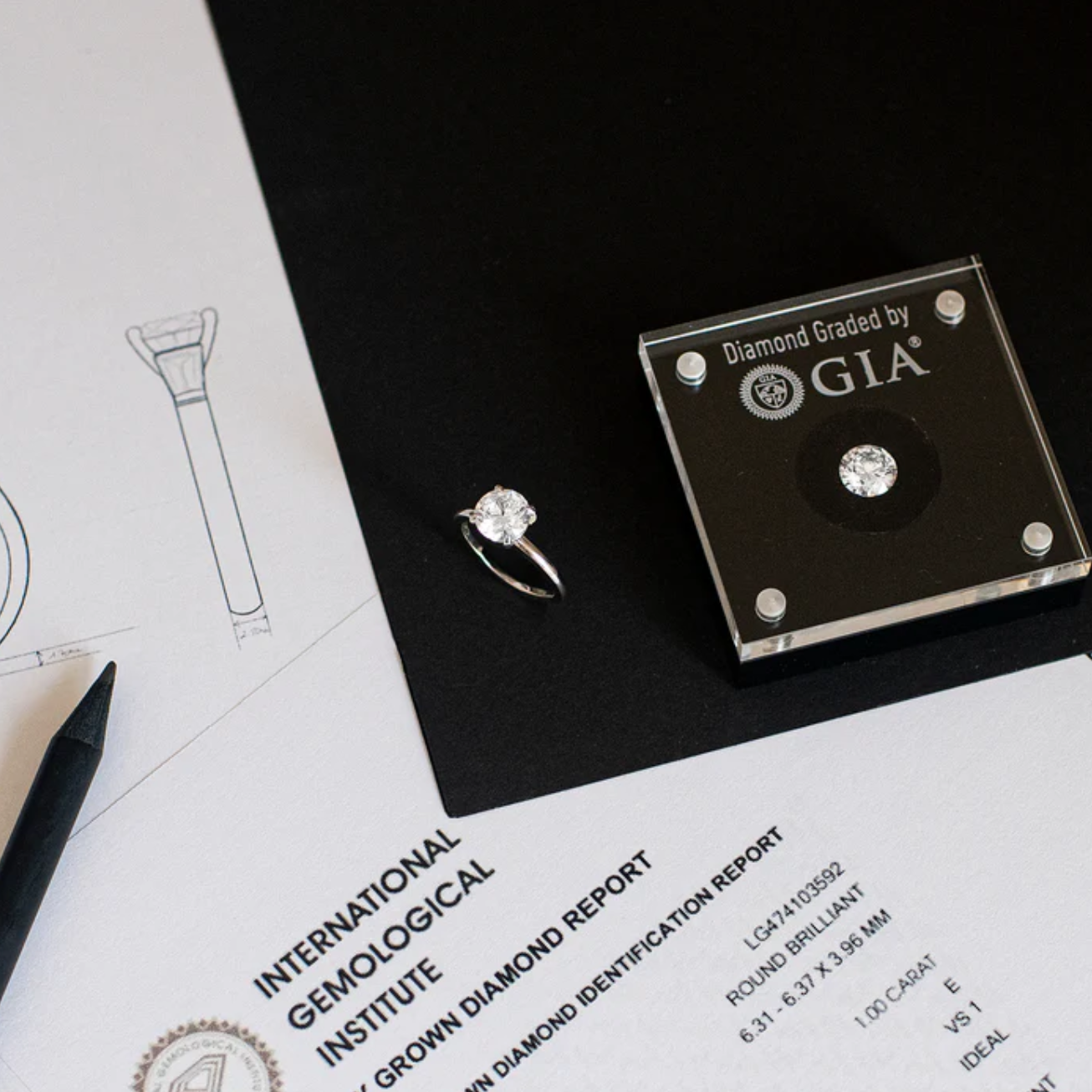
a diamond certificate — also called a grading report — is an independent assessment of a diamond's quality characteristics by a neutral third party. it documents the 4Cs (cut, color, clarity, and carat weight), along with measurements, fluorescence, and often a plotting diagram of inclusions.
without a certificate from a reputable lab, you're relying entirely on the seller's description of the stone. with one, you have an objective, verifiable record of exactly what you paid for — one that matters for insurance, resale, and your own peace of mind.
not all certificates are equal. the lab that graded your diamond determines how much trust the certificate carries — and that's where GIA and IGI differ in important ways.
What is GIA — and what makes it the gold standard?
GIA — the Gemological Institute of America — was founded in 1931 and is the organization that created the 4Cs grading system now used universally across the industry. it's a non-profit research institute, and its grading laboratory is widely considered the most rigorous and consistent in the world.
when jewelers, appraisers, and estate buyers reference a stone's value, a GIA certificate is almost always the benchmark. its grading is conservative — particularly on color and clarity — which means a GIA-graded stone's quality is rarely overstated. this consistency is why GIA-certified diamonds command a resale premium.
GIA's primary focus has historically been natural diamonds, though it has expanded into lab-grown diamond certification in recent years. for a natural diamond that you intend to hold as an investment, or that will be passed down, GIA certification carries the most weight in the broader market.
What is IGI — and why does it dominate lab-grown diamonds?
IGI — the International Gemological Institute — was founded in 1975 and has become the industry leader for certifying lab-grown diamonds. it was among the first major labs to develop comprehensive grading standards specifically for lab-created stones, and it's where most reputable lab-grown diamond sellers send their stones today.
IGI offers faster turnaround and more cost-effective certification than GIA — which matters in the lab-grown market where volumes are high and pricing is more competitive. its reports are detailed, and for lab-grown diamonds in particular, IGI provides information on the diamond's growth method (CVD or HPHT) that GIA reports don't always include.
IGI's grading for lab-grown diamonds is considered highly reliable and accurate. for natural diamonds, its grades can run slightly more lenient than GIA's — meaning an IGI-graded natural stone might receive a marginally higher color or clarity grade than the same stone would receive from GIA. this is worth understanding before comparing prices across certifications.
GIA vs. IGI: side-by-side comparison
| GIA | IGI | |
|---|---|---|
| Founded | 1931 | 1975 |
| Primary focus | Natural diamonds | Lab-grown diamonds |
| Grading strictness | Most conservative in the industry | Slightly more lenient on natural stones; consistent on lab-grown |
| Global recognition | Universally recognized — the industry benchmark | Highly trusted, dominant in the lab-grown market |
| Report detail | Comprehensive — no appraised value included | Comprehensive — often includes appraised value for insurance |
| Lab-grown grading | Available, but secondary focus | Industry leader — includes growth method details |
| Turnaround time | Longer | Faster |
| Cost | Higher certification fee | More cost-effective |
| Best for | Natural diamonds, investment pieces, resale value | Lab-grown diamonds, value-focused purchases |
The grading strictness difference — and what it means for you
this is the most practically important thing to understand when comparing GIA and IGI certificates on natural diamonds. GIA grades conservatively — if a diamond sits on the boundary between two grades, GIA will typically assign the lower one. IGI can grade the same stone one color or clarity grade higher.
in practice, this means that an IGI-graded natural diamond at H/VS1 might be a GIA H/VS2 — or even an I color stone. both certificates are honest; they're just applied with different thresholds. when comparing prices across certifications, this gap is something to account for.
for lab-grown diamonds, this distinction matters much less. IGI's grading of lab-grown stones is widely considered accurate and consistent — which is why the world's leading lab-grown diamond producers use IGI as their certification standard.
the key principle: compare diamonds certified by the same lab when evaluating quality and price. a GIA H color and an IGI H color are not necessarily equivalent on a natural stone — but two IGI-certified lab-grown diamonds at the same grade are directly comparable.
Which certification should you choose?
the honest answer is: it depends on what you're buying and what matters most to you.
- choose GIA if you're buying a high-value natural diamond where resale value, strict grading, and long-term investment matter. GIA is the benchmark the broader market uses to assess value.
- choose IGI if you're buying a lab-grown diamond. IGI is the industry standard for lab-grown certification — detailed, trusted, and what virtually all reputable lab-grown producers use.
- either works if the certificate is from a reputable lab, the stone has been independently graded, and the seller is transparent. what matters is that the diamond is certified — not uncertified.
what to avoid: diamonds sold without any certification from a recognized lab, or certificates from less established labs whose grading standards aren't publicly documented. the certificate is only as reliable as the lab that issued it.
What we use at Juwels & Co — and why
at juwels & co, we work with both GIA and IGI certifications depending on the stone and the collection.
for natural diamonds — including center stones in custom engagement rings and toi et moi pieces where a client is investing in a specific stone — we source GIA-certified diamonds. the grading consistency and global recognition matter for pieces built to last generations.
for lab-grown diamonds, we work with IGI-certified stones. IGI is the standard the lab-grown industry is built on, its reports are detailed and reliable, and it's the certification most relevant to the stones we're working with.
in every case, the certificate comes with your piece. you'll know exactly what you have — the grade, the lab, and the full documentation. if you have questions about a specific stone or want to see the certificate before committing, we're always happy to share it.
Frequently asked questions
certified diamonds, handcrafted in solid gold.
natural and lab-grown — both done with intention.
every diamond we work with comes with a certificate from GIA or IGI. questions about a specific stone? julia is happy to walk you through it.
start your custom diamond piece →


